
An Autism Diagnosis in Adulthood, A New Path to Follow
Marina Sarris
Date Updated: October 7, 2025
Braxton Webb has held plenty of jobs. He was a U.S. Marine Corps reservist, a truck driver, a security guard, and a deputy correctional officer. But he struggled with some of them, as he had in school when he was growing up.
When Webb was 33, he decided to find out why he had those difficulties. He saw a neuropsychologist who gave him the answer: He has autism.
Several years later, he got the answer to yet another question: Why does he have autism? That unexpected answer came from SPARK, the autism research study he joined after his diagnosis.
Now, Webb has a new career goal, one in which he knows he can excel. He also has a new purpose, as the father of two sons, one with autism and the other with autistic traits.
Growing Up With Undiagnosed Autism
Although it’s common to diagnose autism in children, some adults, particularly those born before autism was widely known, missed out on a childhood diagnosis.
In Webb’s case, some educators thought he might have autism when he was in elementary school three decades ago. His mother worried that a label would hold him back or discourage him from doing whatever he wanted to do.
But looking back, Webb, who is now 40, wonders if it would have helped him to have an Individualized Education Program (IEP). An IEP provides special education services for students with autism and other conditions. “I was never in special ed. I wish I had been, because I struggled a lot in school academically,” he says.
He remembers being a little different from his classmates, although he did not know why. “I was real quiet and kind of kept to myself.” He had some of the sensory symptoms of autism. “I could hear sounds that other people didn’t notice. I paid attention to other stuff that people didn’t notice.”
Like many students with autism, whether diagnosed or not, he was also bullied ─ “relentlessly,” he says. Fortunately, the elementary school principal, who knew his mother, put a stop to it.
As a preteen, he became interested in computers. His mother would sometimes take him to work with her on the weekend, and he learned about the computer system there. When she had a problem with her work computer, she would call him for advice on how to fix it, he recalls.
By his teen years, Webb’s self-taught computer skills had advanced to the point that he hooked up the internet system at his high school. “The only thing I didn’t do was the electrical work,” he says.
Career Challenges
After high school, he joined the Marine Corps Reserves in Wisconsin, where he lives. He then held a series of jobs, many in the transportation industry. He drove 18-wheelers and motor coaches and was a ramp agent for an airline. He also worked as a security guard. Eventually he landed what he thought would be his dream job in a sheriff’s department.
He became interested in law enforcement as a child after a good experience with police. When he was about 3, he left the home of an inattentive babysitter and boarded a bus. Police made sure he got home safely.
His first assignment in the sheriff’s department was as a jail officer. There, he struggled with the loud noise, the need to multitask, and other issues working in a jail. Those struggles, and the loss of that job, caused him to see a neuropsychologist for answers. He was not surprised by his autism diagnosis. “I looked up my symptoms online, and it kept coming up as autism,” he says.
An Email From SPARK Brings Surprising News
He learned about the SPARK study online and joined in 2018. He submitted a saliva sample for DNA analysis by researchers. But he did not expect it to lead to anything. Then, in 2021, he received an email from SPARK saying that it had found the reason for his autism. “It was surprising,” he recalls.
A genetic counselor explained to him that he has a rare variation in the DYRK1A gene. Most people with this genetic variant have autism or autistic traits. Symptoms of DYRK1A syndrome may include speech, learning, vision, motor, or feeding problems, a smaller than average head size, or seizures.1
Webb does not have some of the features of this syndrome, but this is not surprising. SPARK Scientific Director Pamela Feliciano, Ph.D., says, “By analyzing tens of thousands of people along the entire spectrum, SPARK is identifying people with rare genetic changes who may have fewer, different, or milder symptoms than previously observed with that particular genetic condition. We are sequencing the DNA of everyone with autism who provides a saliva sample, not just individuals who may have more severe symptoms.”
Webb registered with SPARK’s companion program, Simons Searchlight. Simons Searchlight studies variations to 185 genes, including DYRK1A, that cause rare neurodevelopmental conditions. The program tracks participants’ health over time and shares their anonymous data with researchers who are studying their conditions.
Webb advises Simons Searchlight as a member of its Community Advisory Committee. He joined the program’s private DYRK1A Facebook group, where he met parents of children with the genetic variant. They had questions for Webb, he says, and “I had tons of questions for them.”
A New Career, A New Father
Before his own autism diagnosis, Webb began working at a school and residential treatment center for students with autism and developmental conditions. During his years there, he learned a lot about autism. “When I first started working at the center, it was just a job. But as I worked there more and more, I really enjoyed the work.”
He was working as a behavior therapist to autistic children in 2023 when he decided to begin a family. He started the process of adopting children from the foster care system. He knew that these children were more likely to have experienced trauma or to have disabilities. But with his work and personal experiences, “those are my specialties,” he says.
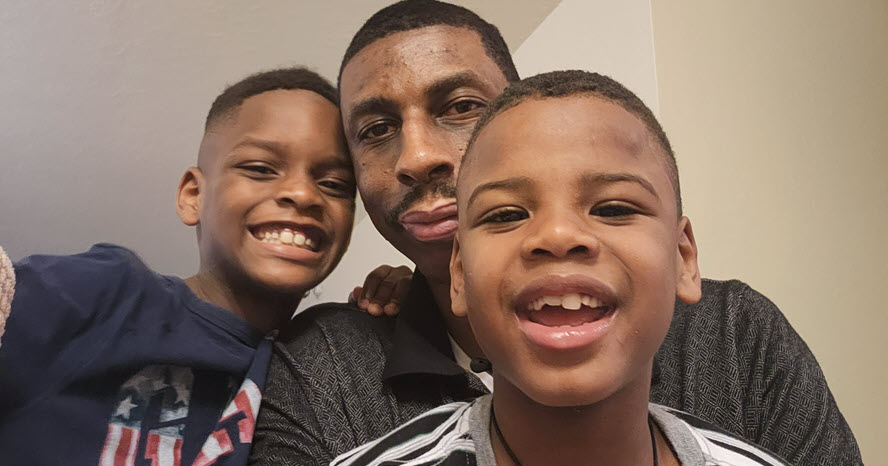
He adopted two brothers with developmental and medical conditions. The youngest, Marquise, 9, has autism and seizures. His brother, 11-year-old Kayden, has ADHD and autistic symptoms, says Webb, a single parent. He registered both boys in SPARK, with Kayden participating as a sibling.
His sons have wandered or run from safe places, a common behavior in autism that is called elopement.
One summer morning, he drove one of his sons to camp before starting work. The boy was having a bad day and tried to run toward traffic near the camp. Webb kept him safe, but in the stress of the moment, he forgot to call his office and tell them he would be late.
His employer reprimanded him for being late, and Webb objected. He lost his job. His children’s behavior can be unpredictable, which can make full-time work difficult, especially if employers are not understanding, he says.
He works part-time jobs, such as a delivery driver and as staff at summer camps. His days are filled with school meetings and weekly therapy and medical appointments for his sons. It’s busy, but “I wouldn’t trade it for the world,” he says.
He says his personal and work experiences guide him when he helps his sons manage their emotions and behavior. “When they’re having a meltdown, with my experience and patience, I’m able to remain calm through stressful situations where other people wouldn’t be able to,” he says. “I meet them where they are at that particular moment.” Some autistic parents say that they understand their autistic child because they share similar traits, according to a small study.2
A New Career Goal
Webb would like to open a childcare center for autistic children. He knows there is a need for such services. “A lot of people in the childcare industry don’t want to have that clientele because of the difficulty,” he says.
But for Webb, this is a welcome challenge, one that would allow him to help families much like his own.
Interested in joining SPARK? Here’s what you should know.
Photo courtesy of Braxton Webb.