
Seeking a Roadmap to Raising Children With Level 3 Autism
Marina Sarris
Date Published: October 6, 2026
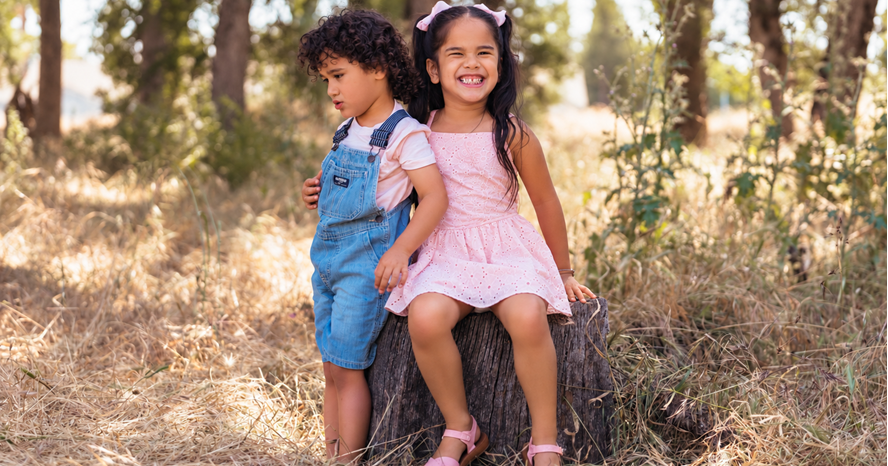
Laura Youker is careful. She has door locks and chains to keep her young daughter and son from running away, a common behavior in autistic children, like hers.
But one day a delivery created a distraction, and a door chain went unfastened. Quickly and quietly, the children escaped their house in Northern California. The family began looking frantically for Marley and Carter, fearing they would get lost or hurt.
They found Marley, but not her brother, Carter. Police arrived, and their helicopter found Carter an hour later. He was uninjured and headed toward a park.
Keeping them safe, and finding the services they need, is not easy. Marley, who is 7, and Carter, who is 5, have level 3 autism. That means they require the highest level of daily support among people on the autism spectrum.
The children do not speak and have learning disabilities and developmental delays. They also have some behaviors, including running away from safe places, that can place them in danger.
But there is much more to this sister and brother. They are affectionate children who love hugs, fireworks, cake pops (Marley), Spider-Man (Carter), and all varieties of food, even broccoli.
Youker joined the SPARK autism study to expand what we know about level 3 autism, which affects an estimated one-fourth of autistic people. “I would like to know more about what causes them not to be able to speak,” she says.
The Baby Who Didn’t Cry
Youker knew when Marley was just a baby that she was different. “She never, never cried, and I would say, ‘Marley, Marley,’ and she wouldn’t look at me.” Marley’s head seemed large, too, she says.
Others downplayed her concerns. “Oh, you’re just thinking this,” they told her. But Youker was not an anxious first-time mom. She had two older children, one of whom was already an adult. “There was a huge difference between my other kids, and her,” she recalls.
Marley learned several words as a toddler, such as mama and daddy, but she gradually stopped talking. It seemed like when she gained a new skill, she would lose an older skill, her mother says.
Near her third birthday, Marley was diagnosed with autism. By that time, Youker had given birth to a son, Carter. Like Marley, he had a larger-sized head and a similar developmental path to hers. By age 3, he had the same diagnosis as his sister.
Navigating the Path to Autism Services and Therapies
Youker worked diligently to find services for her children through community, school, government, and insurance agencies and programs. Her previous job, as executive assistant to the vice president of an insurance company, was good training for this work. “I’m good at navigating systems,” she explains.
She enrolled her children in occupational, speech, and behavioral therapies, adaptive swimming lessons, and a gym program for autistic children. She or her husband take their children to activities daily.
The family uses an adaptive stroller, which is designed for older children, to keep the siblings from running or wandering away in parking lots or at community outings.
Almost half of children with autism wander or run away from safe places, which is called elopement.1 About 17 percent of cases of elopement resulted in an autistic person’s death, according to a report by The National Autism Association.2
To further protect her children, Youker got them GPS trackers to help find them if they elope. But Carter outsmarted his tracker on the day he was found by a police helicopter. He had removed the clothing containing the tracker while he was wandering from home.
Youker’s children have had episodes of self-injury, which has been linked to being non-speaking in one SPARK study.3
Marley and Carter are learning to use an augmentative and alternative communication (AAC) system. Their AAC system is a program on an electronic tablet that allows nonspeaking people to select pictures and words to communicate. The children particularly like tapping the icons for “big” and “doughnut,” to let her know they want that treat, she says.
They also lead their mom to what they want and have learned to point. Many young autistic children do not naturally point to show interest in something.
A Different Type of Sensory Reaction
Like others on the spectrum, the siblings experience input from their senses differently from people who do not have autism. Many autistic people are very sensitive to their senses: lights are too bright, sounds too loud, smells too strong, and textures too uncomfortable.
But Marley and Carter have the opposite reaction. They are among the autistic people who seek out sensory experiences. They enjoy being hugged, running and moving, and all textures and smells of food. “They love the 4th of July fireworks. They are into action and people and noise,” their mother says. “I’m lucky that way.”
While many autistic children will only eat food of a certain texture, color, or smell — chicken nuggets are a common favorite — Marley and Carter have no such requirements. On the advice of an occupational therapist, Youker began introducing new foods to them daily when they were toddlers. They are adventurous eaters. She packs their lunches with cheese, crackers, salami, and olives.
The children are in constant motion. Youker put a step counter on Carter and recorded a stunning 37,000 steps in one day. Concerned, she called his doctor to see if he was OK. The doctor told her to make sure both children drink enough water daily to prevent dehydration.
Sharing Her Autism Journey With Others
Parents of newly diagnosed children usually aren’t given a roadmap of the available autism services and supports, and how to find them. Youker has created a map of her own and shares that information with others.
As an “older mom,” Youker says, she talks with younger mothers of autistic children, to provide whatever help she can. “I couldn’t imagine being 20, 21, or 22 years old, and having an autistic kid, and not knowing how to find all these kind of things. So I’ve directed them to services that I’ve found through a lot of research. Because no one really tells you about what help is out there.”
Another way Youker contributes to the autism community is by participating in research. She serves on SPARK’s Community Advisory Council. She also has taken part in SPARK Research Match, which connects people to studies by researchers across the world.
Youker’s family also contributes to other studies. Marley joined a university study of autistic children with large heads. The study is examining a link between head size and a type of autism that affects a subset of people.
Youker hopes that research will lead to better therapies, especially for speech. She would like to hear her children’s voices. “I just hope someday that they’ll start talking, and if they don’t, that’s okay. I just want them to be able to communicate, even if it’s through the AAC device.”
She knows that her children have a lot to say to the world. When she looks in their eyes, “I see glimmers of how smart they are.”
Interested in joining SPARK? Here’s what you should know.
Photo by Lisa Nottingham, with permission of Laura Youker.