
Once Blamed for Her Son’s Autism, Mother Learns the Real Cause From SPARK
Marina Sarris
Date Published: January 6, 2026
Arletta and Michael Rinier sat in the office of the psychiatrist evaluating their 3-year-old, Michael Jr., for autism. Arletta was holding her second son, a four-week-old infant.
The doctor blamed Arletta for Michael’s autism: she paid too much attention to her newborn and not enough to Michael, he said. The year was 1970, when many doctors still believed in the theory that autism was caused by cold, uncaring mothers. “Back in the day, autism was considered the refrigerator mother syndrome,” Arletta recalls.
That type of blame, coming from a doctor, could be crushing, particularly for young parents who had never heard of autism. But the Riniers were made of sturdier stuff. Michael Sr. shrugged off the doctor’s words. “This guy’s nuts,” he told his wife afterwards.
Arletta, who was 22, agreed that the doctor must be wrong. But this expert left her with a tiny, nagging doubt, one that she carried with her for years. “I continued to pursue other answers. There had to be more than what they were telling me,” she recalls.
As the years passed, scientists found other answers. Multiple research studies showed that autism was rooted in biology, not parenting. More than 50 years later, Arletta would learn a reason for Michael’s autism, with the help of the SPARK autism research study. “It lightened my load to know that,” she recalls.
Raising an Autistic Child When Autism Was Rare
Michael Jr. was the first of four children born to the Riniers, who married after Arletta graduated from high school. “He had snapping black eyes and thick black hair, and he was the most precious baby I had ever seen,” Arletta recounted in her book, “My Son Has Autism: What I Have Learned.”1
As a toddler, Michael stopped speaking the few words that he had. He stared intently at the spinning wheels of a toy car, rather than at the family around him. And he would wander or run away if the Riniers took their eyes off him, even for a moment.
The family’s journey to a diagnosis was far rockier than many people experience today. Autism was considered a very severe, and very rare, condition at the time. Despite that, the Riniers still found their way to specialists in the Los Angeles area, where they lived.
When he was 4, Michael was admitted for weeks of testing and observation at a program for autistic children at UCLA Medical Center. “We wanted some answers to why our son wasn’t talking, why he would awaken in the middle of the night and giggle for hours, and why he had no communication skills and no receptive skills,” Arletta recounted in her book. After leaving Michael at the hospital, its walls painted a dingy gray, she cried all the way home.
Then a curious thing happened when it was time to discharge Michael from the hospital. Staff told the Riniers that their son had intellectual disability, but not autism. “A woman explained that Michael had autistic symptoms, but he does not have autism and do not tell people he does,” she recalls. That made no sense to his parents. More than one doctor had talked to them about autism before that hospital stay.
“That’s the Way Him Is”
Michael grew up before autism was recognized as a spectrum condition. Only those few with the most significant symptoms, and access to medical experts, received the diagnosis.
Autism awareness and acceptance, as we know it now, did not exist. “Most people didn’t understand, even if you tried to explain it to them,” recalls Michael’s sister, Jennifer. Some people were not nice to him, she says.
Arletta remembers when Michael’s brother John, who was just 4, introduced his older brother to his curious friends. “That’s my brother Michael,” John said. “Him don’t talk.”
“Why not?” one of the other boys wanted to know.
“That’s the way him is,” John replied.
Jennifer, their younger sister, said that she did not invite friends over to the house “unless they REALLY knew us and the situation because his odd behaviors could make people uncomfortable,” she says. Michael’s behaviors sometimes included pacing in the hallway when he was upset and pinching his sister if she got too close.
Michael attended school with children with significant disabilities. When he was in elementary school, his family moved to Oregon. Teachers and speech therapists worked on his communication skills. But Michael did not speak. He also did not use sign language and picture symbols consistently.
That left Michael unable to tell someone when another student abused him on the school bus during high school. An aide saw and reported the abuse, but the school district took several weeks to respond and notify his parents. His parents filed a complaint that resulted in a new requirement that the district report the abuse of special education students immediately.
“Every Classic Symptom in the Book”
Arletta never understood why UCLA told her that Michael had autistic behavior, but not autism, when he was a child. When he was 20, Michael was re-evaluated by another specialist. Arletta wanted to know, does Michael have autism or not?
Michael has autism, the new doctor concluded. Arletta recalls the doctor’s exact words: “He has every classic symptom in the book.”
The Riniers left that appointment wondering if they had been discouraged from calling Michael autistic in the early 1970s to improve his chances of attending school. At that time, the U.S. government did not require states to educate all students with disabilities. Given how little was known about autism at the time, would a school be reluctant to admit an autistic child?
The Last Suitcase
As a young adult, Michael developed behaviors that became hard to manage. He became upset around the time his family renovated their house. He stopped eating, lost weight, and slept poorly. Doctors ruled out medical problems. Reluctantly, his family decided he needed a change. “The time had come for Michael to move on and for me to let go,” Arletta recounted in the book.1
She felt devastated and guilty as she packed the last suitcase he would take from her home. He moved into adult foster care while he waited for another placement.
Over the years, she kept a close watch over Michael while he lived in group homes. When wearable tracking devices became available, she struggled to get Michael one so police could find him if he wandered away. One group home complained that the tracker required too much work for them. But eventually she found a device that the staff would accept.
A few years ago, she visited him at the home where he was living and noticed that something was wrong. “He looked like he was going to pass out, and I couldn’t get his attention,” she recalls.
She made sure he got to the hospital. He was diagnosed with sepsis, a potentially life-threatening condition triggered by infection.
She later learned that the group home had neglected his personal care, meals, and toileting, she says. Shocked, she transferred him to a new home with better care.1
“Michael has autism and it was not my fault!”1
In 2016, Arletta learned of the SPARK autism study, which launched that year. SPARK is trying to expand what we know about the biology of autism. Arletta and Michael became one of SPARK’s first families when they joined and contributed saliva for researchers to analyze. Michael Sr. had passed away a decade earlier.
In 2022, SPARK notified the family that it found the cause of Michael’s autism. He has a variation in his CUL4B gene on the X chromosome. Boys get their X chromosome from their mothers, but Arletta did not have the variant, she learned. The variation occurred in Michael’s DNA before he was born.
The CUL4B gene makes a protein that is important for brain development. CUL4B syndrome helped explain why Michael has autism, intellectual disability, tremors, and short stature.
Getting this genetic news was a relief for Arletta, even though doctors had told her over the years that the refrigerator mother theory was wrong. “It was a load off my mind. I had been told repeatedly that Michael’s condition was not my fault. But as a mom, I thought, what did I do? Did I do this wrong?”
Arletta, who is remarried, shared the news with her other two sons and daughter. Her grandchildren could not inherit a CUL4B change. She also shared the information with Michael’s doctor.
A Love for the Open Road
Today Michael is living in a home where he receives good care, Arletta says. He enjoys watching the fish in his 35-gallon aquarium, which his nephew maintains for him.
But his favorite thing to do is ride in the car. Arletta believes that car rides remind him of the road trips his family took across the United States when he was a child. “We were on the road three or four weeks, and he really enjoyed it.”
When he has wandered away, he has tried to get into parked cars, she says. Maybe he is hoping to enjoy the thrill of a long road trip again, she wonders.
Interested in joining SPARK? Here’s what you should know.
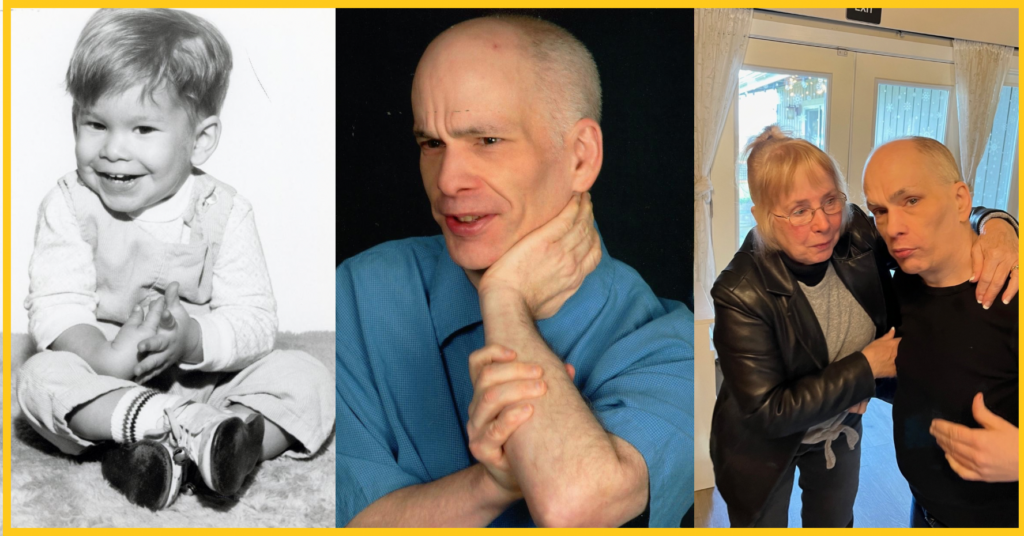
Photo credit: Arletta Rinier Riedler
References
- Rinier A. My Son Has Autism: What I Have Learned. Middletown, DE: A.K. Riedler (2025)