
SPARK Research Match Report: How Does Physical Activity Affect Sleep in Autistic Adults?
Date Published: May 19, 2026
This is a SPARK Research Match Summary Report. It describes results from newly published research using data from SPARK participants.
Study title
Sleep and Activity Patterns in Autism
What was the study about?
This study explored how sleep and physical activity are different in adults with autism compared with family members who do not have autism.1
How was the research done?
For the study, 318 autistic adults and 130 of their family members without autism wore activity trackers on their wrists for three weeks. These devices recorded their movements and how much light they were exposed to during the day and night. All participants completed surveys about social skills and kept a daily record of how well they slept. Participants did not have intellectual disability and were ages 18 to 60. Many were recruited through SPARK.1
What did the researchers learn?
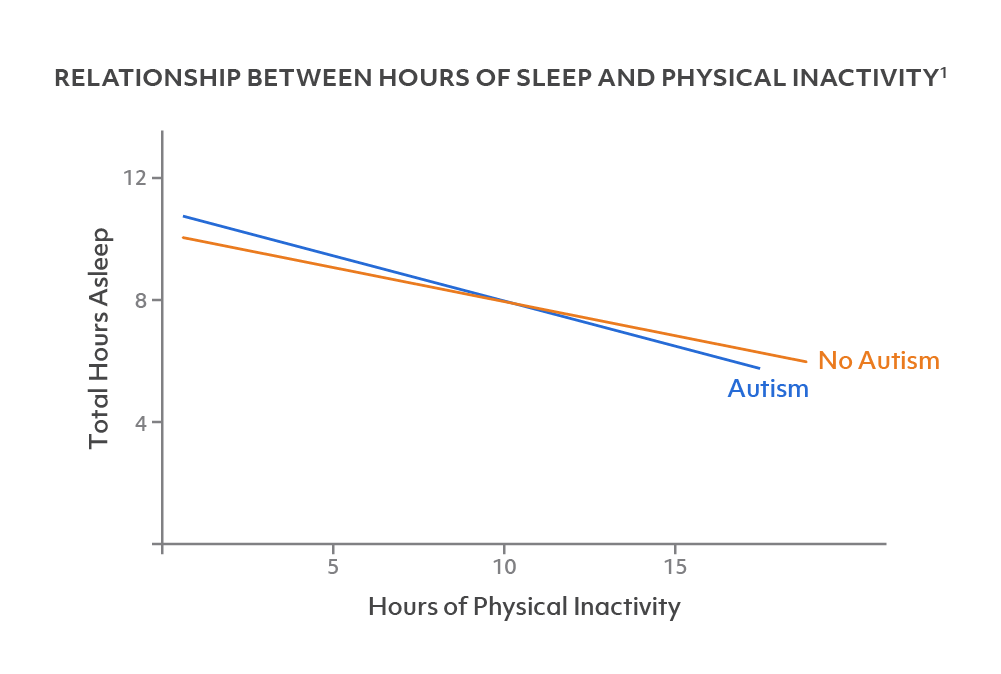
- There is a strong connection between being physically inactive, such as sitting still, and sleeping less. Being inactive caused everyone to lose sleep, but it affected autistic adults more than their relatives without autism. For every extra hour of inactivity, autistic adults lost about 23.5 minutes of sleep while their relatives lost about 17 minutes.1
- Autistic adults had less regular sleep habits than their family members. Their bedtimes, wake-up times, and how long they slept changed more from day to day compared with their relatives.
- Autistic participants who were less physically active had more challenges with social skills.
- Autistic participants with rare variations in NOS1, a gene related to sleep, had less physical activity.
What was new and innovative about the study?
This is the largest study to track sleep and activity in autistic adults using wearable tracking devices for at least three full weeks. Researchers analyzed more than 300 different sleep and activity measurements using machine learning, a type of artificial intelligence (AI).1
What do the findings mean?
Physical activity is linked to better sleep and social skills. The researchers suggest that programs to help autistic adults exercise more could improve their sleep and overall quality of life.1
What are people saying?
Study participants:
- “It was easy and hopefully helps research. Thanks for letting me participate.”
- “Although the daily follow-through challenged my executive functioning a LOT some days, I very much enjoyed knowing that I was participating in the study. It felt very gratifying. I look forward to learning more through the results!”
- “The communication was great and the instructions clear. The watch was easy to return.”
- “Very easy, great experience.”
Study researcher Maja Bućan, Ph.D., professor, University of Pennsylvania:
“There are numerous publications reporting sleep problems in children with autism. Many of these are based on parent reports and questionnaires. Our study is more objective because we combine questionnaire data with information collected from a wrist-worn device. In addition to identifying specific sleep problems, we report a significantly lower level of physical activity in autistic individuals. We hope our findings will provide a basis for therapies that improve the regularity of sleep-wake and light-dark cycles.”
What’s next?
Future sleep studies should include larger groups of autistic children and adults and use different sensors and tests to monitor them. Researchers should study treatments that could improve sleep by increasing a person’s physical activity and exposure to light during the day, according to the study team.
References
- Weissenkampen J.D. et al. Autism 30, 767-787 (2026) PubMed
Staff used an artificial intelligence tool, NotebookLM, to help summarize the research. Quotes came from participants and researchers. Staff and a researcher edited and reviewed the content.
About SPARK Research Match
This SPARK program matches participants with research studies that they may want to join. These studies have been evaluated for scientific merit and approved by a scientific committee at SPARK. The program is free to researchers and participants. SPARK does not endorse or conduct these studies. Participants choose if they want to take part in a particular study.