
SPARK Research Match Summary Report: Does an Online Survey Tool Enable Teens and Young Adults With Autism and Developmental Disabilities to Report on Their Needs Accurately?
Date Published: November 19, 2025
This is a SPARK Research Match Summary Report. It describes results from newly published research using data from SPARK participants.
Study title
Psychometric properties of the Pediatric Evaluation of Disability Inventory – Patient Reported Outcome: A cognitively accessible measure of functional performance
What was the study about?
Many assessment surveys are not made for people with intellectual and developmental disabilities (IDD) to share their needs and opinions. This means that other people often fill out surveys for or about them. But parents, teachers, or healthcare providers might not see things the same way that they do. Researchers wanted to test a computer survey tool to see if it worked well for people with IDD.
How was the research done?
More than 300 people ages 14 to 22, some of whom were in SPARK, used the Pediatric Evaluation of Disability Inventory – Patient Reported Outcome (PEDI-PRO) Assessment Software to answer questions about everyday skills. In the total group, 43 percent had autism, 24 percent had intellectual disability (ID), 11 percent had autism and ID, 18 percent had other conditions, and 4 percent did not identify their disability. More than half identified as African American/Black, Asian, Hispanic/Latino, or multiple racial identities. The survey looked at skills that are important for adulthood. Researchers checked to see if the PEDI-PRO gave accurate results.
What did the researchers learn?
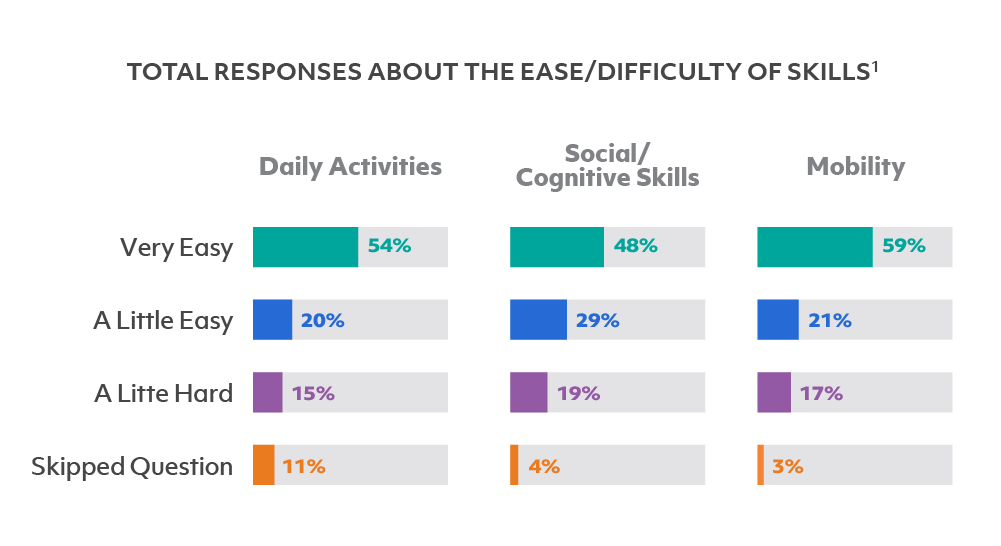
- Researchers evaluated almost 100 questions on the survey and removed those that did not work well. The remaining questions showed that the survey measured the right things in each skill area.1
- Scores did not change based on a person’s age, gender, or race and ethnicity.
- The scores on the PEDI-PRO are similar, but not exactly the same, as scores that parents provided on a similar assessment called the PEDI-CAT (Pediatric Evaluation of Disability Inventory – Computer Adapted Test). The research team discussed the parents’ scores in a separate paper.
What was new and innovative about the study?
The PEDI-PRO was developed in collaboration with youth with disabilities. Few assessment tools are designed for youth with IDD to complete by themselves.
What do the findings mean?
Teens and young adults with autism, intellectual disability, and other developmental conditions can use this tool to show what skills they have or need to work on. It works equally well across different ages, genders, and races and ethnicities. This information can be useful in planning for life after high school.
What are people saying?
Study participants:
- “Wonderful research staff. Staff gave directions slowly about study objective and consent, and ensured my [child] understood before continuing.”
- “The researchers were very friendly and made the process very easy.”
- “They were polite and very understanding and patient with my [child].”
- “I really didn’t think that my [child] would be able to go through the whole thing, but I was so surprised and astounded at the workmanship of [staff members]. I would have to say that just working with them alone was 500 percent better than working with [another organization]. They’re so organized and patient. They seem to care about the children and are amazing working with them!”
Study researcher Jessica M. Kramer, Ph.D., OTR/L, associate professor, University of Florida:
“The PEDI-PRO was developed with teens and young adults with disabilities over many years. This may explain why the PEDI-PRO worked so well. Teens and young adults with disabilities can use the PEDI-PRO to report functional skills they may need to improve as they become adults.”
What’s next?
Future research can identify how changes on the PEDI-PRO scores match real-life changes in skills. This could provide young adults, families, and healthcare providers with evidence of meaningful change.
References
- Kramer J.M. et al. Dev. Med. Child Neurol. 67, 770-778 (2025) PubMed
About SPARK Research Match
This SPARK Program matches participants with research studies that they may want to join. These studies have been evaluated for scientific merit and approved by a scientific committee at SPARK. The program is free to researchers and participants. SPARK does not endorse or conduct these studies. Participants choose if they want to take part in a particular study.