
SPARK Research Match Report: Identifying Depression in Autistic Adults With Limited or No Speech
Date Published: June 3, 2026
This is a SPARK Research Match Summary Report. It describes results from newly published research using data from SPARK participants.
Study title
Parent-Reported Indicators of Depression in Non- and Minimally Speaking Adults With Autism
What was the study about?
This study looks at how to identify depression in autistic adults with limited or no speech. Up to 30 percent of autistic people use no words, few words, or limited three-word phrases. The mental health of these adults is not studied as often as in autistic adults who speak fluently.1
How was the research done?
Parents of 152 autistic adults with little or no speech completed online multiple-choice questionnaires about the adult’s mood, behavior, and anxiety. Parents also answered open-ended questions: Did they believe their adult child was depressed? Also, what were the reasons and behaviors that caused them to answer yes or no? Researchers compared the responses of parents/guardians who suspected the autistic adults were depressed to those who did not. The autistic adults were ages 18 to 68, and two-thirds had intellectual disability.1
What did the researchers learn?
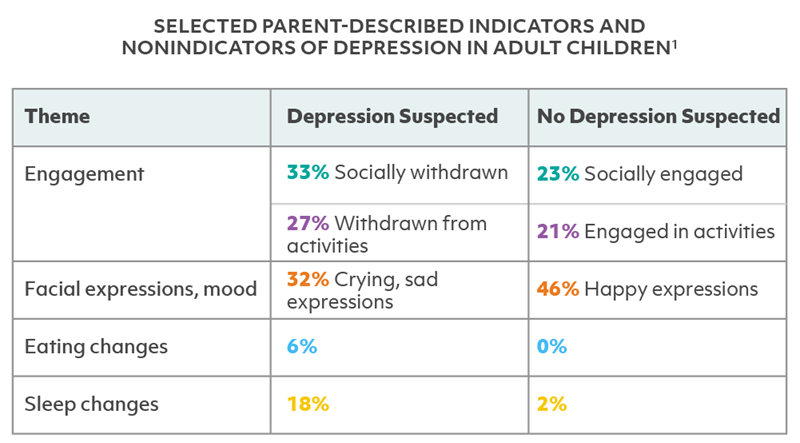
- Forty percent of the parents suspected that their adult child was depressed, although only 7 percent of them had been diagnosed with depression by a professional.1
- Parents who suspected depression mentioned their child’s sad facial expressions, crying, withdrawing from social situations, and having very low energy. They also reported changes in sleep and eating habits, and aggressive behaviors.
- Repetitive behaviors and strict routines are common in autism, but parents still saw them as related to depression when they saw a change in these behaviors.
- Parents who said that their child was not depressed often mentioned behaviors such as smiling, being in a happy mood, and showing interest in social activities.
What was new and innovative about the study?
This was one of the first studies to look at depression in autistic adults who speak few or no words. This study also used open-ended questions, which enabled parents to describe their own observations.1
What do the findings mean?
Depression may be underdiagnosed in autistic adults who cannot describe their mood. Parents described symptoms – sadness, low energy, and social withdrawal – that match typical depression symptoms. This shows the need for screening and monitoring of mental health in autistic adults with limited speech, the researchers said.1
What are people saying?
Study participants:
- “This is a very needed and serious subject…. It has been a significant issue in our home.”
- “I have not thought about this topic before today. It brings up an interesting idea where I wonder if behaviors that we see could be tied to depression, which is hard to diagnose in an individual like our [adult child] who has low communication skills.”
- “Some questions were a relief to be asked. Thank you.”
Study researchers:
Ellen Wilkinson, Ph.D. candidate, Rutgers University: “The high rate of parents’ concern highlights the need to monitor mental health in this population and identify when there is a need for intervention. The parents describe depression symptoms similar to the general population, as well as others that may be dismissed, as they are associated with autism – for example, insistence on routine. These symptoms, especially when there is a change from how someone normally is, should be considered when assessing the mental health of minimally speaking autistic people.”
Vanessa H. Bal, Ph.D., professor, Rutgers University: “This study really highlights the importance of considering mental health in autistic people who have limited speech. Signs of depression and other co-occurring conditions may be overlooked or assumed to be features related to autism. These results suggest we need to increase awareness and understanding of mental health needs of minimally speaking autistic adults. Careful attention to monitoring and screening is important to ensure that these adults get the support they need.”
What’s next?
Future research should explore how to incorporate the perspectives of autistic adults with little or no speech when assessing their mental health, the researchers said. These studies should include people from a range of racial and cultural backgrounds. More research could lead to new or adapted tools to screen for depression in adults with limited speech.
References
- Wilkinson E. et al. Am. J. Intellect. Dev. Disabil. 131, 171-186 (2026) Abstract
Staff used an artificial intelligence tool, NotebookLM, to help summarize the research. Quotes came from participants and researchers. Staff and a researcher edited and reviewed the content.
About SPARK Research Match
This SPARK program matches participants with research studies that they may want to join. These studies have been evaluated for scientific merit and approved by a scientific committee at SPARK. The program is free to researchers and participants. SPARK does not endorse or conduct these studies. Participants choose if they want to take part in a particular study.