
SPARK Research Match Report: How Does Race Relate to Depression Symptoms and Diagnosis in Autistic Adults?
Date Published: July 22, 2026
This is a SPARK Research Match Summary Report. It describes results from newly published research using data from SPARK participants.
Study title
Racial Disparities in Depression and Mental Health Service Use Among Black and White Autistic Adults
What was the study about?
Autistic people are more likely to have depression than people who are not autistic. For Black autistic people, this risk may be higher due to experiences of racism. This study looked at how depression and mental health care differ between Black and white autistic adults.1
How was the research done?
For this study, 93 Black autistic adults and 86 white autistic adults completed online surveys about their backgrounds, mental health history, and current symptoms. Participants were recruited through SPARK and other autism groups. The researchers matched the Black and white participants by age and income so that comparisons would be fair. The studycompared people who had ever received a depression diagnosis to people who had never been diagnosed.1
What did the researchers learn?
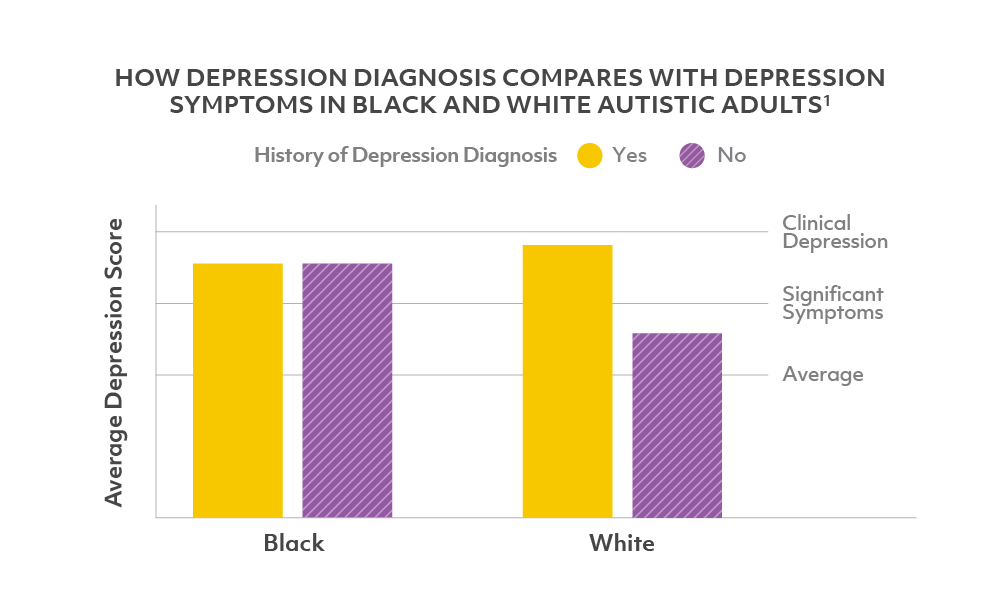
- Among white autistic adults, those who had a depression diagnosis reported feeling more depressed and anxious than those without a diagnosis.1
- Black autistic adults reported high levels of depression and anxiety regardless of whether they had ever been diagnosed with depression.
- Among Black autistic adults, those without a depression diagnosis were much less likely to take antidepressant medicine than those with the diagnosis. Both groups, however, had similar levels of current depression symptoms.
- Among Black participants, those who had a depression diagnosis tended to have higher incomes, more education, and full-time jobs.
- For white participants, their social and economic statuses were not linked to their likelihood of having a depression diagnosis. Factors such as age, income, education level, and job status did not differ between those who got a depression diagnosis and those who didn’t.
What was new and innovative about the study?
Few studies have examined the mental health experiences of Black autistic people compared to white autistic adults. This study looked at both their history of a depression diagnosis along with their current mental health symptoms.1
What do the findings mean?
The study suggests that many Black autistic adults have undiagnosed depression compared with white autistic adults. The study found that income and education played a role in receiving a depression diagnosis for Black participants, but not for white participants. This suggests differences in access to, and experiences with, mental health care related to race.
What are people saying?
Study participants:
- “I think people with autism generally have a poor quality of life, and I hope that studies like this mean it can be improved in the future.”
- “The spectrum of people with autism is so vast I imagine it was difficult to come up with a comprehensive survey. You may want to ask about additional mental illnesses besides those you listed.”
- “Thank you for your research in the adult community with autism. It’s underrepresented in many ways.”
- “I enjoy these studies because sometimes they teach me new things or prompt me to look into them.”
Study researcher Ed-Dee G. Williams, Ph.D., M.S.W., assistant professor, Boston College:
“A key finding from our study was that Black autistic individuals without a formal depression diagnosis reported depressive symptom levels nearly identical to those with a diagnosis, often near clinical thresholds, suggesting widespread underdiagnosis and gaps in effective mental health care for this population. The study addresses a critical gap in understanding how depression is experienced and diagnosed among Black autistic individuals, a group that has been largely overlooked in mental health research despite elevated risk and systemic barriers to care. It really highlights how intersectional factors, such as race and neurodivergence, shape access to diagnosis, treatment, and overall mental health outcomes.”
What’s next?
Future studies should include more people of different income and education levels, who also should be followed over time, the study says. The researchers recommended improvements to the assessment and treatment of depression in Black autistic people.1
References
- Williams E.G. et al. Sci. Rep. 16, 4617 (2026) PubMed
Staff used an artificial intelligence tool, NotebookLM, to help summarize the research. Quotes came from participants and researchers. Staff and a researcher edited and reviewed the content.
About SPARK Research Match
This SPARK program matches participants with research studies that they may want to join. These studies have been evaluated for scientific merit and approved by a scientific committee at SPARK. The program is free to researchers and participants. SPARK does not endorse or conduct these studies. Participants choose if they want to take part in a particular study.