
SPARK Research Match Report: Does the Age of Autism Diagnosis Relate to Life Satisfaction in Adulthood?
Date Published: June 16, 2026
This is a SPARK Research Match Summary Report. It describes results from newly published research using data from SPARK participants.
Study title
The Relationship Between Age of Autism Diagnosis and Life Satisfaction in Adulthood
What was the study about?
This study explored the relationship between the age at which people are diagnosed with autism and their satisfaction with aspects of their lives in adulthood.1
How was the research done?
In this study, 769 autistic adults completed online surveys about how old they were when diagnosed with autism and about their current autistic traits. They answered questions about how satisfied they felt with their social lives, independence, work or school, and their overall well-being, also called flourishing. The participants were ages 18 to 78, and many were recruited through SPARK.1
What did the researchers learn?
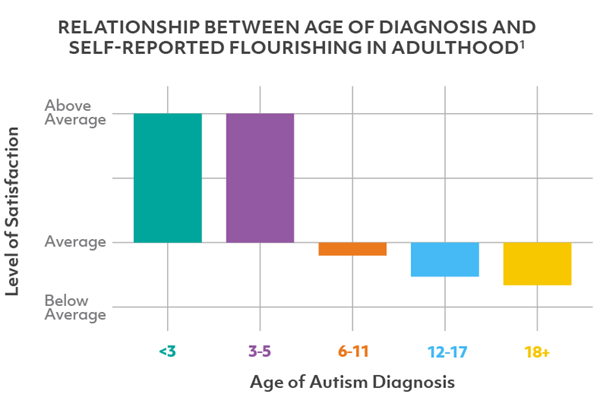
- Autistic adults diagnosed between ages 3 and 5 reported being more satisfied with their independence, social lives, and overall well-being in adulthood than those diagnosed as adults.1
- Similarly, adults diagnosed before age 3 said that they were more satisfied with their social lives and independence than people diagnosed in adulthood.
- People diagnosed in middle childhood (ages 6 to 11), as teenagers (ages 12 to 17), and as adults reported less satisfaction with aspects of their lives than those diagnosed in early childhood.
- The age that someone was diagnosed was not related to how satisfied they were with their work or schooling.
- People diagnosed as adults were more likely to be older when they took part in the study, assigned female at birth, identify as a sexual minority, and not have an intellectual disability. They also reported having higher levels of autistic traits.
What was new and innovative about the study?
Compared with previous research, this study included more people and a broader range of diagnosis ages, including many diagnosed as adults. The study looked at adults’ satisfaction with aspects of their lives using surveys that were created for autistic people.1
What do the findings mean?
Autistic people diagnosed in early childhood reported greater satisfaction in adulthood than people diagnosed after age 5, but this study cannot tell us why. For example, it’s possible that getting diagnosed earlier helps people receive services that then lead to a better quality of life in adulthood. It’s also possible that people diagnosed at older ages had other conditions that delayed their autism diagnosis and also affected their satisfaction levels in adulthood.1
What are people saying?
Study participants:
- “Loved the study and learned a lot more about myself.”
- “Thank you for breaking the long survey up into many little pieces. It made it less overwhelming than if it had been one huge one.”
- “I appreciate the opportunity to help others through my own experiences. I also appreciate that my time and life are cared enough about to study! Thank you for paying us sometimes too. It helps out a lot.”
- “I appreciate how straight-forward the questions were.”
Study researchers:
Jessie Northrup, Ph.D., assistant professor, University of Pittsburgh School of Medicine: “While this study cannot tell us what causes differences in life satisfaction amongst adults diagnosed at different ages, the findings suggest there may be a tipping point for age of diagnosis. Differences in life satisfaction were much larger between people diagnosed in early childhood verses adolescence than between those diagnosed in adolescence verses adulthood. This pattern is consistent with the idea of an early window when supports could be especially beneficial, while later diagnosis may coincide with fewer resources and additional social or emotional challenges.”
Stacy Cremer, B.S.: “More research and attention should be directed towards how to support people who were diagnosed with autism at an elementary school age and beyond.”
What’s next?
Future studies should explore which autism traits have the biggest effect on life satisfaction, along with outside factors such as stigma and discrimination. To understand cause and effect, studies should follow the same people over a long period of time after their diagnosis, the study said.
References
- Cremer S. et al. Autism 30, 931-943 (2026) PubMed
Staff used an artificial intelligence tool, NotebookLM, to help summarize the research. Quotes came from participants and researchers. Staff and a researcher edited and reviewed the content.
About SPARK Research Match
This SPARK program matches participants with research studies that they may want to join. These studies have been evaluated for scientific merit and approved by a scientific committee at SPARK. The program is free to researchers and participants. SPARK does not endorse or conduct these studies. Participants choose if they want to take part in a particular study.