
SPARK Research Match Report: How Do Gastrointestinal Symptoms Affect Autistic Youth?
Date Published: March 5, 2026
This is a SPARK Research Match Summary Report. It describes results from newly published research using data from SPARK participants.
Study title
Gastrointestinal Symptoms in Autistic Youth: Relation to Age, Sex, and Functional Impact
What was the study about?
Many autistic children and teenagers have gastrointestinal (GI) symptoms, such as constipation, gas, and abdominal pain. This study looked at how GI symptoms affected their daily lives. The researchers also wanted to learn if the types of GI problems, and their effects, differed based on the person’s age and sex.
How was the research done?
The parents of 2,142 autistic youth in SPARK answered online questionnaires about whether their child had GI symptoms in the past week and whether those symptoms affected the child’s daily activities. The study focused on constipation, diarrhea, irregular stools, stool smell, gas, and abdominal pain. The youth were aged 6 to 17. Eighty-two percent were boys, and 18 percent were girls.
What did the researchers learn?
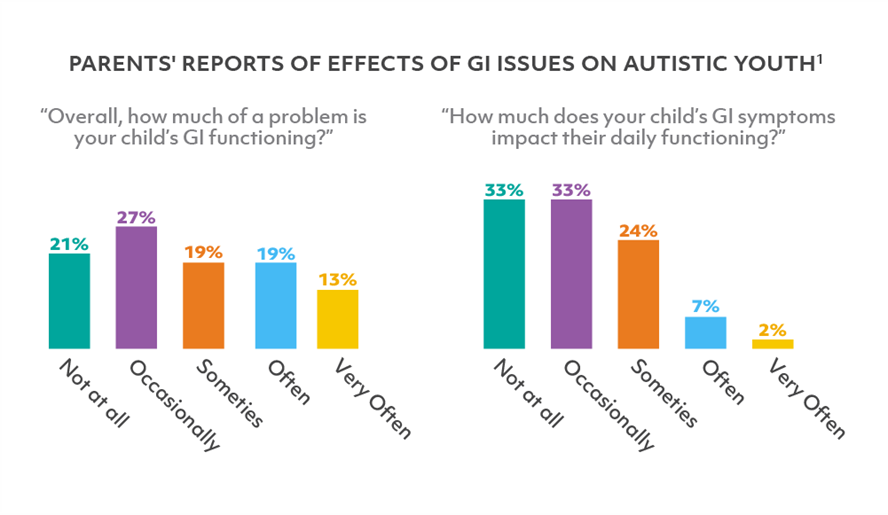
- Abdominal pain was the symptom that was strongly linked with interference in youths’ daily activities.1
- Girls had higher rates of abdominal pain and gas than boys.
- Parents of girls said that their child’s GI problems interfered more with their daily activities than parents of boys reported.
- The amount of GI issues, and their effect on daily activities, stayed about the same from age 6 to 17. Older girls did not have more abdominal pain than younger girls, even though older girls were more likely to begin having periods.
- Constipation was the most frequent symptom, affecting 56 percent of the youth. It affected boys and girls similarly.
- Children with more constipation problems had less gas and pain, according to their parents. Constipation often causes gas pain. It’s possible those children may not be communicating their pain to their parents, researchers say.
What was new and innovative about the study?
This study was one of the first to focus on how GI problems affect the daily activities of autistic youth, and to study the differences based on their sex and age.
What do the findings mean?
GI symptoms, particularly abdominal pain, interfered with the daily lives of some autistic children and teens. Girls were the most affected by gas and pain. Doctors could consider how these symptoms affect a child’s ability to participate in different activities when they are treating a GI problem.
What are people saying?
Study participants:
- “My child was constipated [when they were] younger. This is no longer the case.”
- “I feel the questions and research are important in learning more about ASD and how it affects children and adults.”
- “My child takes gastrointestinal aids to assist in regularity. Without it, they were irregular and also they take sleep aids.
- “I am a holistic practitioner and coach, and these topics are extremely important to me…. We pay close attention to nutrition, digestive health, emotional health, self-care, self-regulation, etc. Thank you for your work!”
Study researcher Cynthia E. Brown, Ph.D., assistant professor, Pacific University:
“Given that boys and girls have differences in only two of the six GI symptoms, I think it was surprising that parents are saying GI symptoms are impacting girls more than boys. My interpretation is that the symptom of abdominal pain is particularly impairing, compared to the other symptoms.”
What’s next?
Future research could study why autistic boys and girls are affected differently by GI issues. Youth also could be asked directly about GI problems, because they may not always tell their parents about them, Brown says.
References
- Ramsey T.E. et al. Res. Autism 131, 202786 (2026) Abstract
About SPARK Research Match
This SPARK Program matches participants with research studies that they may want to join. These studies have been evaluated for scientific merit and approved by a scientific committee at SPARK. The program is free to researchers and participants. SPARK does not endorse or conduct these studies. Participants choose if they want to take part in a particular study.