
SPARK Research Match Summary Report: Does Sexual Identity Affect Whether Autistic Adults Mask Their Autism Traits?
Date Published: September 24, 2025
This is a SPARK Research Match Summary Report. It describes results from newly published research using data from SPARK participants.
Study title
Self-reported masking in sexual minority and heterosexual autistic adults
What was the study about?
Masking occurs when people on the autism spectrum hide their autistic traits, either consciously or unconsciously, in social situations. Previous studies found a link between masking and mental health problems. Researchers wondered if an autistic person’s sexual identity affects the amount of masking that they do. Autistic people are more likely than others to identify as a sexual minority, such as gay, bisexual, asexual, pansexual, or queer. Does being a member of multiple minority groups, such as being autistic and gay, lead to more masking in public?
How was the research done?
About 460 autistic adults in the SPARK study completed the Camouflaging Autistic Traits Questionnaire and reported their sexual identities. The adults, who were ages 18 to 50, did not have guardians or intellectual disability. Researchers designed the study so that half of the adults were heterosexual, and half were gay, bisexual, or another sexual identity.
What did the researchers learn?
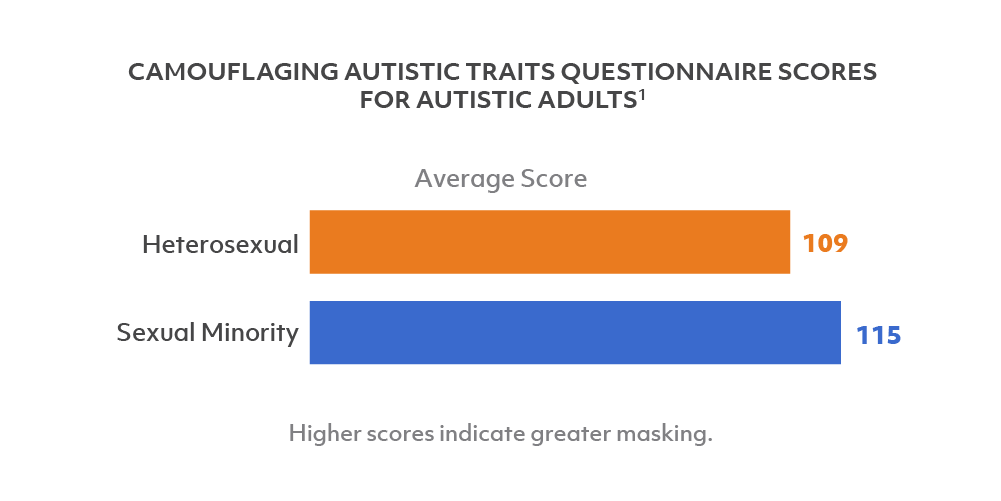
- Autistic adults who are sexual minorities masked their autistic traits more often than autistic people who are heterosexual. Researchers considered other factors that could affect masking, such as sex assigned at birth and age, in their analysis.1
- Adults who were assigned female at birth masked their autistic traits significantly more than autistic adults assigned male at birth. Similarly, other studies have found that autistic women report more masking than autistic men.
- Autistic adults who were assigned female at birth were more likely to have a sexual minority identity.
What was new and innovative about the study?
This study is believed to be the first to compare masking by autistic adults who have a sexual minority identity with masking by autistic adults who are heterosexual.
What do the findings mean?
Adults who have a sexual minority identity masked their autistic traits more often than heterosexual autistic people. Research has linked masking to mental health concerns, such as stress, anxiety, and depression, in autistic people.
What are people saying?
Study participants:
- “I think it’s really great that you’re asking such important and heavy questions that I haven’t seen being asked from anywhere else.”
- “Very interesting study, made me think about how my behaviors and personality could relate to my autism.”
- “Please accept my thanks for deciding to study how adults with autism are doing in their lives. It feels like most of the funding out there is directed at either determining genetic causes of autism or therapeutic treatments for children.”
Study researcher Goldie A. McQuaid, Ph.D., research assistant professor, George Mason University:
“Autistic masking is associated with an impact on mental health, and that is why it’s important to study. We also know, from research, that sexual minority individuals who are not autistic have higher levels of social stress and mental health problems. That’s why we want to look at the intersection of identities where someone is autistic and also a sexual minority individual.”
Study researcher Gregory L. Wallace, Ph.D., professor, The George Washington University:
“There is growing debate on what the link is between masking and mental health. There’s no doubt there is a link, but is it directly cause and effect? We need the data to see what is driving what.”
What’s next?
Wallace’s research team is conducting a study that asks autistic adults about stress from being a minority, such as being autistic and/or LGBTQ+, and how their different identities contribute to that stress. They are also looking at how different gender and sexual identities, combined with autism, affect a person’s experiences of stress, mental health, and masking. Previous studies have looked at gender and sexual identities separately in autistic people.
References
- McQuaid G.A. et al. Autism 29, 2137-2150 (2025) PubMed
About SPARK Research Match
This SPARK Program matches participants with research studies that they may want to join. These studies have been evaluated for scientific merit and approved by a scientific committee at SPARK. The program is free to researchers and participants. SPARK does not endorse or conduct these studies. Participants choose if they want to take part in a particular study.