
SPARK Research Match Report: Does an Autism Diagnosis Change How Parents Respond to Their Child’s Negative Emotions?
Date Published: April 2, 2026
This is a SPARK Research Match Summary Report. It describes results from newly published research using data from SPARK participants.
Study title
Associations Between Child Characteristics and Parent Response to Emotion Differ in Young Children With and Without an Autism Diagnosis
What was the study about?
The study looked at how parents respond when their young child is upset or has negative emotions. Researchers wanted to learn if parents of autistic children responded differently than parents of children without an autism diagnosis. Did a child’s traits, such as trouble managing their emotions and social challenges, change the way that parents responded?
How was the research done?
The parents of 812 autistic children and the parents of 968 children without an autism diagnosis completed online surveys. The children were ages 2 to 5, and most of the autistic children participate in SPARK. Parents read about 12 imaginary situations in which their child got upset and rated how they would likely react. Parent reactions were grouped into three categories: supportive (comforting the child), non-supportive (punishing the child or minimizing their emotions), or distressed (getting angry).
What did the researchers learn?
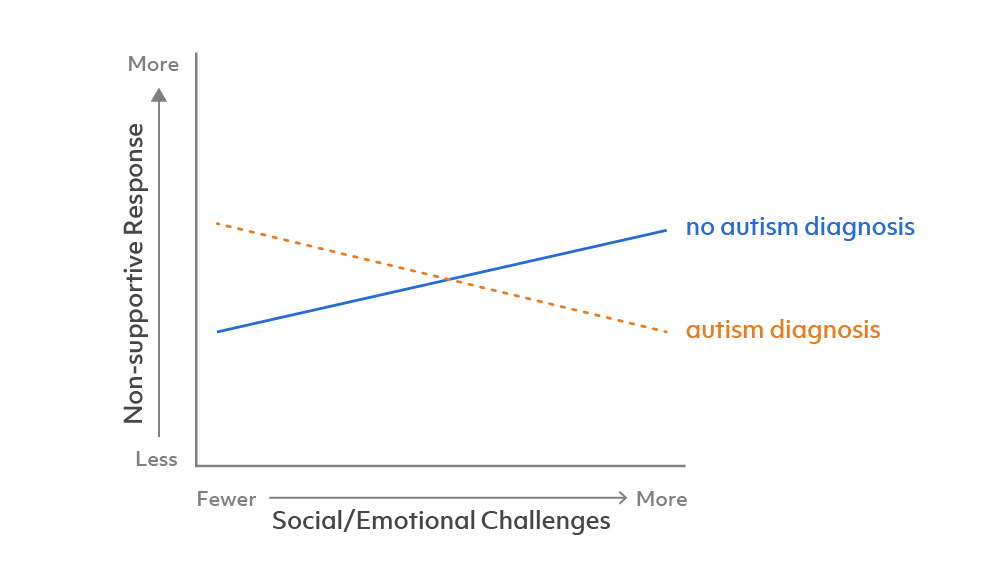
- Parents of autistic children reported slightly more supportive — and less non-supportive or distressed — responses to their children’s negative emotions than parents of children without autism.
- Among parents of children without an autism diagnosis, having a child with more social and/or emotional challenges was linked to more non-supportive and distressed responses.
- Among all the children studied, those who had fast, intense emotional outbursts received more supportive responses.
- Children who were more unhappy and uneasy received more unsupportive responses from their parents, regardless of whether they had autism.
What was new and innovative about the study?
This study is among the first on this topic to include many young children and to compare families of children with and without an autism diagnosis.It also examined how different types of emotional struggles — explosive anger versus sadness and uneasiness — affect how parents respond.
What do the findings mean?
Getting an autism diagnosis might help parents understand their child more and explain why the child is acting out. Parents whose children have social and/or emotional challenges but do not have a diagnosis of autism tend to respond to their child’s negative emotions in more frustrated and unsupportive ways. Some of those undiagnosed children may have autism. An early diagnosis may help parents better support their child.
What are people saying?
Study participants:
- “Great questions. It really captured my child’s behavior and parent experience.”
- “This survey made me really think about my own child’s behavior and reaction to situations as well as my own behavior towards [them] as a parent.”
- “Thank you for taking the time to ask the tough questions. It reminds me our family is not alone.”
Study researcher Jessie Northrup, Ph.D., assistant professor, University of Pittsburgh School of Medicine:
“One of the most encouraging findings from our research, which has been shown by prior research as well, is that parents of autistic children were, on average, using lots of supportive strategies when responding to their child’s emotions — even slightly more so than parents of children without a diagnosis. At the same time, many young children who struggle socially or emotionally may not yet have a diagnosis, and these are the families who seem to be struggling the most with how to respond to their child’s big emotions. Parents of these children reported more punitive, minimizing, and distressed reactions than parents of children with similar traits who had already been identified as autistic. Our findings underscore the value of early recognition and the need to support every parent navigating developmental and emotional challenges — diagnosis or not.”
What’s next?
Future researchers should observe how parents and children interact in real life, the study team said. Researchers could also study families over a longer period to see how the parents’ reactions and the children’s behavior relate to one another over time.
References
- Northrup J.B. et al. Autism 30, 525-537 (2026) PubMed
Staff used an artificial intelligence tool, NotebookLM, to help summarize the research. Quotes came from participants and researchers. Staff and a researcher edited and reviewed the content.
About SPARK Research Match
This SPARK program matches participants with research studies that they may want to join. These studies have been evaluated for scientific merit and approved by a scientific committee at SPARK. The program is free to researchers and participants. SPARK does not endorse or conduct these studies. Participants choose if they want to take part in a particular study.