
SPARK Research Match Report: Do Couples Raising an Autistic Child View Their Relationship Differently Than Couples Raising a Child Without Autism?
Date Published: August 20, 2026
This is a SPARK Research Match Summary Report. It describes results from newly published research using data from SPARK participants.
Study title
Examining Relationship Quality Dimensions in Couples Raising Autistic and Nonautistic Children
What was the study about?
Researchers wanted to find out how raising an autistic child affects a couple’s relationship. To do so, they compared couples with an autistic child to couples whose child does not have autism. The study measured different aspects of a romantic relationship, such as conflict, communication, intimacy, how couples manage stress, and overall happiness.
How was the research done?
The researchers studied 108 couples with an autistic child in SPARK, and 109 couples whose child did not have autism. Each parent answered an online survey about their relationship, including intimacy, power dynamics, and their overall satisfaction. Couples participated in a 60-minute video call during which they were asked to discuss a relationship problem and try to solve it. All the couples lived together, and 90 percent were married.1
What did the researchers learn?
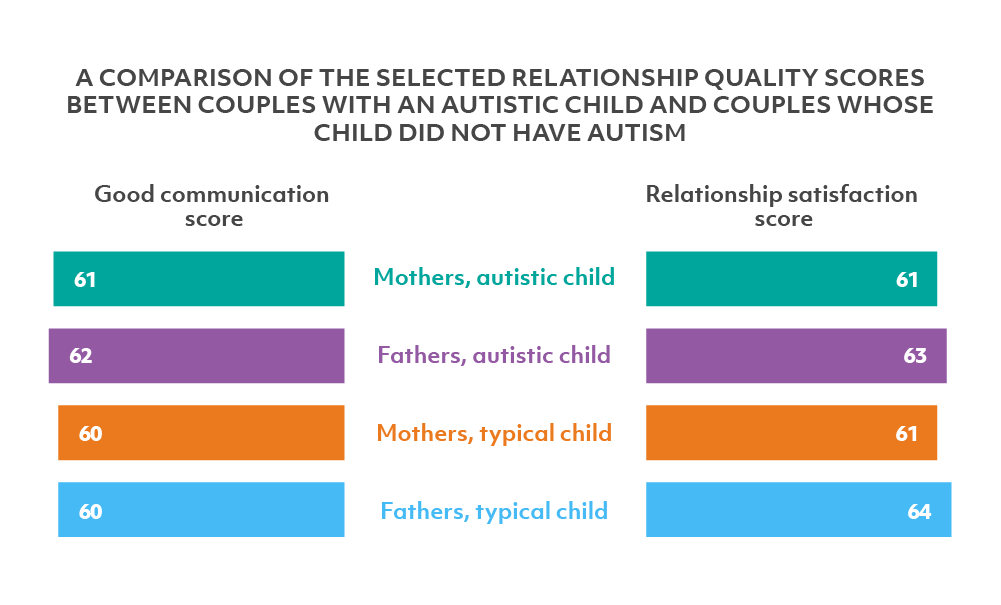
- There were no major differences in relationship quality between couples with an autistic child and couples whose child did not have autism.1
- Mothers in both groups were generally less satisfied with their relationships than fathers were. This may be linked to how parenting duties are distributed between mothers and fathers.
- Mothers and fathers did not differ in any of the other areas measured, such as conflict, communication, intimacy, power dynamics, or how they manage stress together.
What was new and innovative about the study?
Past research focused on couples’ conflict and satisfaction with their relationship. This study examined those aspects, along with intimacy, power dynamics, and how couples handle stress together. This study was larger and included more people from different backgrounds than earlier studies.1
What do the findings mean?
Couples appeared to show resilience in their relationship even though they may experience added stress while raising an autistic child. The study did not include parents who had ended their relationships.
What are people saying?
Study participants:
- “It was very easy to complete and the team communicated effectively.”
- “Well organized and friendly staff.”
- “It was a nice study to participate in, very appropriate topic for many parents, something we all struggle with, communication when under so much stress.”
- “The study was well-run, and it was easy to participate.”
Study researchers:
- Chrystyna Kouros, Ph.D., professor, Southern Methodist University: “Our findings so far suggest that, across many dimensions of relationship quality, couples raising an autistic child are more similar to couples raising a nonautistic child than different.”
- Naomi Ekas, Ph.D., professor, Texas Christian University: “As researchers and the press focus on the potential negative impacts of raising an autistic child, perhaps they are overlooking the strong resilience in these relationships.”
What’s next?
Researchers suggest following couples over a long period of time to see how their relationship changes. They also suggest measuring how much each parent helps with child care and household chores to see if it affects how happy they are within their relationship.
References
- Sullivan W. et al. J. Fam. Psychol. Epub ahead of print (2026) PubMed
Staff used an artificial intelligence tool, NotebookLM, to help summarize the research. Quotes came from participants and researchers. Staff and a researcher edited and reviewed the content.
About SPARK Research Match
This SPARK program matches participants with research studies that they may want to join. These studies have been evaluated for scientific merit and approved by a scientific committee at SPARK. The program is free to researchers and participants. SPARK does not endorse or conduct these studies. Participants choose if they want to take part in a particular study.