
SPARK Research Match Summary Report: How Do Autistic Youth Engage in Their Special Interests?
Date Published: August 28, 2024
This is a SPARK Research Match Summary Report. It describes results from newly published research using data from SPARK participants.
Study title
The How Rather than the What: A Qualitative Analysis of Modalities and Caregiver Descriptions of Special Interests in Autistic Youth
What was the study about?
Researchers surveyed parents and guardians of autistic youth about their children’s special interests. Most autistic youth have an intense interest in an object, topic, or activity. Researchers wanted to learn the different ways that youth engage in their interests, and whether caregivers viewed these ways as helpful or not helpful.
How was the research done?
Parents of 1,922 children under age 18 in the SPARK study completed an online survey, including open-ended questions, about their child’s special interests. The children’s average age was 9, and almost 80 percent were boys.
What did the researchers learn?
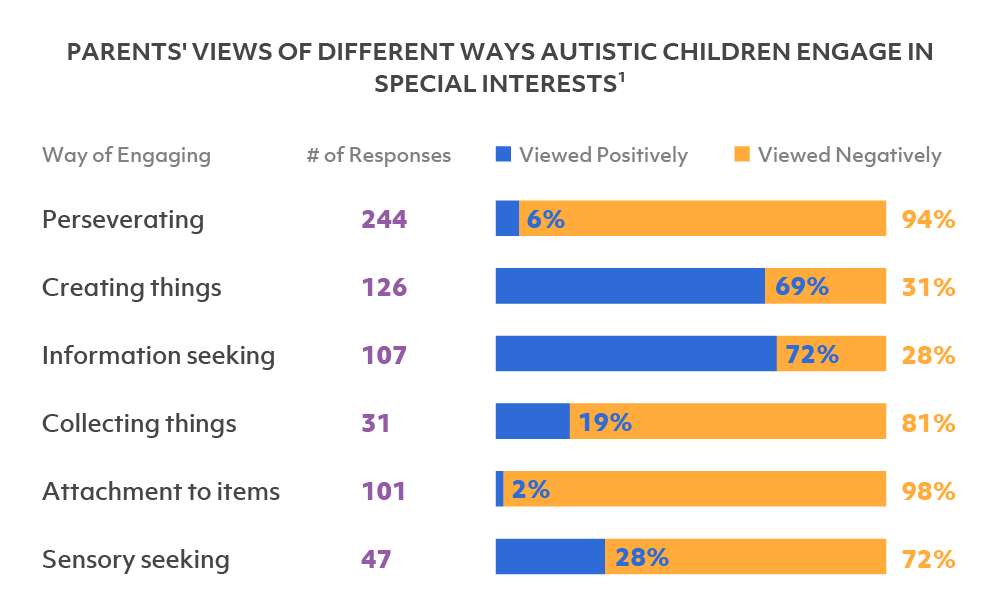
- Researchers identified eight ways that youth engaged in their special interest: perseverating (such as watching the same video over and over), creating (making or building something), seeking out information about it, memorizing facts, collecting items, being very attached to an item (refusing to be without it), seeking sensory experiences (such as chewing on clothes), and self-soothing (such as hugging a toy to calm down).1
- Most parents viewed perseverating, collecting things, sensory seeking behavior, and being attached to items as being unhelpful to their children.
- Most parents viewed two ways of engaging with interests as helpful: creating something (a painting or a block tower, for example) or seeking information about the interest. Parents were split on the helpfulness of memorizing and self-soothing behaviors.
- Parents often viewed certain interests as skills or abilities, such as music, reading and writing, building, art, math, numbers, animals, plants, and maps. But many parents saw interests in TV, objects, collecting things, time, and toys as not helpful to their child.
- Some interests, such as objects, were viewed negatively and were engaged with in ways that were seen as unhelpful, such as needing to always have the object.
What was new and innovative about the study?
Previous studies have focused on what autistic children were interested in. This is among the first studies to investigate how youth engage in these interests and how parents perceive these ways of engaging.
What do the findings mean?
Parents’ views of special interests appear more connected to how the child engaged in the interest than what the interest was. They often saw repetitive behaviors and being very attached to an object as not helpful. But they viewed their children’s efforts to learn about their interest, and to create or build things, as helpful.
What are people saying?
Study participants:
- “I am happy to know that these issues are being studied so that they may be understood better. Having research/data to back-up experiences is very valuable – especially in how it relates to educational development, in my opinion. Thank you!”
- “As a parent of an autistic [child], I genuinely appreciate any research that is being done to help understand these children.”
- “I just want to say thank you for the studies because I know it’s helping you all out to find out answers for us that are looking for answers.”
Study researcher Cynthia E. Brown, Ph.D., assistant professor, Pacific University:
“Almost all autistic people have special interests, and these interests are something that they devote a lot of time and energy to. These interests can guide your career choices and what kinds of activities you do and can be a big part of your identity. That’s why it’s important for us as researchers to learn more about them.”
What’s next?
Research team members want to revise a special interest survey to separate topics of interest from ways of engaging in them, and to ask autistic youth about their interests, Brown says. They also hope to create a survey to measure interests in autistic adults. A future study could compare the differences in interests between youth with and without autism, she says.
References
- Brown C.E. et al. J. Autism Dev. Disord. Epub ahead of print (2024) PubMed
About SPARK Research Match
This SPARK Program matches participants with research studies that they may want to join. These studies have been evaluated for scientific merit and approved by a scientific committee at SPARK. The program is free to researchers and participants. SPARK does not endorse or conduct these studies. Participants choose if they want to take part in a particular study.