
SPARK Research Match Report: What Do Autistic Young Adults Say About Their Strengths and Difficulties?
Date Published: September 15, 2026
This is a SPARK Research Match Summary Report. It describes results from newly published research using data from SPARK participants.
Study title
Self-Reported Strengths and Difficulties by Autistic Young Adults
What was the study about?
Researchers wanted to learn about the strengths and difficulties of autistic adults by asking them directly. Many earlier studies asked parents, teachers, or others about the strengths and challenges of autistic people, particularly children.
How was the research done?
Researchers recruited 295 autistic adults from the SPARK study. These participants answered two open-ended questions online: “What are your strengths?” and “What are your primary difficulties at this time?” The adults were 18- to 35-years old and did not have guardians. The research team gave codes to the responses and grouped the codes into themes and sub-themes.1
What did the researchers learn?
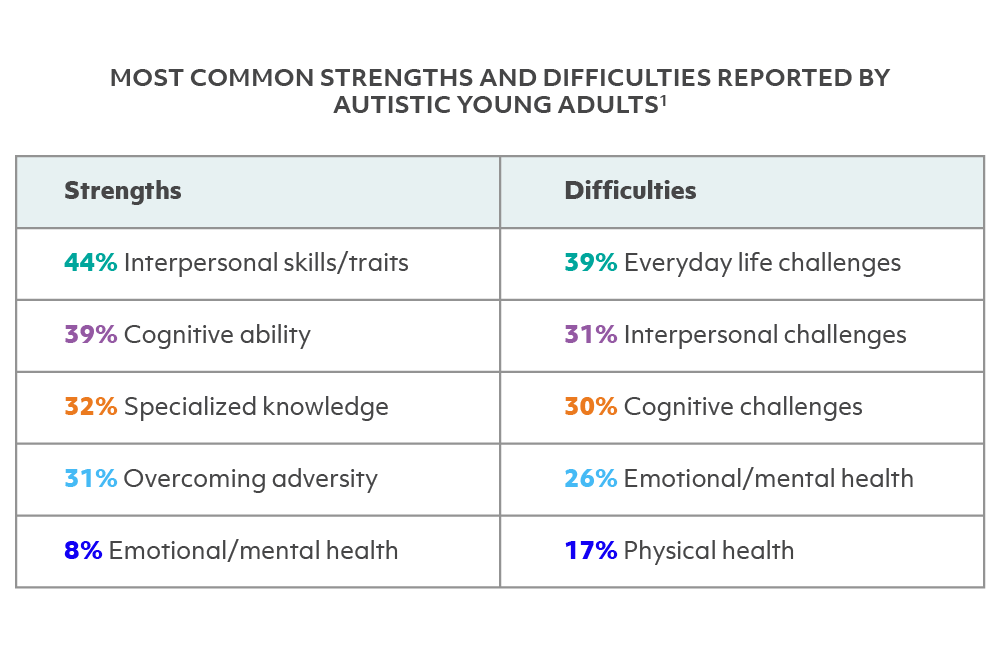
- Autistic young adults said that their strengths included people skills (such as being kind, caring, and loving), cognitive ability (intelligence, planning, creativity), special knowledge/interests (reading, science, and technology), overcoming adversity (resilience), and emotional and mental health (self-awareness).1
- The participants reported difficulties with everyday challenges (such as problems with money and jobs), people skills (socializing), cognitive challenges (organization, time management, focus, motivation), emotional and mental health (anxiety, depression), and physical health (pain, sleep, and sensory problems).
- Some of the strengths and difficulties that they reported were not directly related to autistic traits.
- The same trait can be either a strength or a challenge, depending on the situation, according to participants. For example, being very detail-oriented could be annoying in one situation, but helpful in another. Some adults said that they socialize well in some circumstances, but not in others.
What was new and innovative about the study?
This study used open-ended questions, rather than multiple choice, so participants could answer the way they wanted. The researchers also did not prompt the participants to discuss strengths or difficulties that have traditionally been linked to autism.
What do the findings mean?
Autistic adults reported a wide range of strengths and struggles. Many of the adults reported complex problems with jobs, money, and health. They may need coordinated services, like job coaching, financial advice, and health supports, the study says.
What are people saying?
Study participants:
- “I love the work you guys are doing!”
- “It was a good study.”
Study researcher:
Shuting Zheng, Ph.D., assistant professor, The University of Texas at Austin: “Our study highlights that strengths and difficulties perceived by autistic adults themselves are of a wide range, and contexts really matter for individuals to capitalize on their strengths. Our findings highlight the importance of expanding our perspectives beyond autism-related traits and thinking about a strength-based approach to support autistic adults.”
What’s next?
Future studies should include participants with a broader range of ages, races, and communication preferences, including those who use alternative communication methods, the study says. Studies could use in-depth interviews to explore the background and reasons for the strengths and difficulties that people identify.
References
- Ferraiolo J. et al. J. Autism Dev. Disord. Epub ahead of print (2026) PubMed
Staff used an artificial intelligence tool, NotebookLM, to help summarize the research. Quotes came from participants and researchers. Staff and a researcher edited and reviewed the content.
About SPARK Research Match
This SPARK program matches participants with research studies that they may want to join. These studies have been evaluated for scientific merit and approved by a scientific committee at SPARK. The program is free to researchers and participants. SPARK does not endorse or conduct these studies. Participants choose if they want to take part in a particular study.