
SPARK Research Match Report: What Do Autistic Adults Say About Their Strengths and Talents?
Date Published: January 21, 2026
This is a SPARK Research Match Summary Report. It describes results from newly published research using data from SPARK participants.
Study title
Self-reported Strengths and Talents of Autistic Adults
What was the study about?
Many autism assessments ask about people’s challenges but pay less attention to their strengths. Most of what we know about strengths comes from surveys of parents of autistic children. Researchers wanted to learn directly from autistic adults about their strengths and talents.
How was the research done?
About 125 autistic adults, most of whom are SPARK participants, answered open-ended questions about their strengths and talents in an online survey. The adults were aged 20 to 70. All were independent, which means they did not have guardians. Almost half had a college or graduate/professional degree. Half were diagnosed before age 21, and half were diagnosed at 21 or older.
What did the researchers learn?
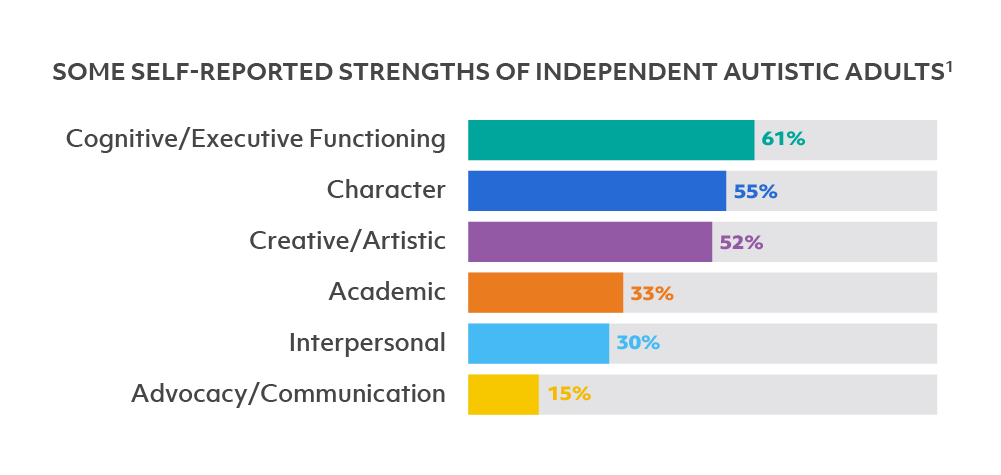
- More than 60 percent of the adults, particularly those with a college degree or higher, reported strengths in cognitive and executive functioning skills. This category included logical thinking, attention to detail, recognizing patterns, organization, and focus.1
- The second most common strength was character, such as goodwill, determination, patience, humor, and flexibility.
- About one half of the participants, particularly young adults, said that they were creative or artistic. Their skills included drawing, painting, sculpting, crafting, and music. “I play music by ear well enough my band mates noticed,” one participant said.
- One third of the adults reported academic strengths, such as reading and math.
- Some adults reported strengths in areas that are often considered difficult for autistic people. Thirty percent cited their interpersonal skills, such as being empathetic and a good listener. Fifteen percent said that they had strong advocacy and communication skills.
- Other areas of strength, reported by less than 15 percent of the adults, included technology, memory, physical fitness, animal care, cooking and baking, and sensory perception. Older adults were more likely than younger people to cite their technological skills.
What was new and innovative about the study?
This study was one of the first and largest to ask independent autistic adults to report on their strengths. The research team included people with and without autism.
What do the findings mean?
Autistic adults described many strengths, especially thinking skills. Almost a third of the participants reported having good people skills, which can also be challenging in autism. “Some of these areas are broad and include many different skills. You can have difficulties and have strengths in the same area, depending on what skills you are looking at,” says study researcher Vanessa H. Bal, Ph.D. Autistic adults should be asked about both strengths and challenges, she says.
What are people saying?
Study Participants:
- “I enjoyed this study as I was able to complete it in sections, and it really had me think of where I am at in life.”
- “Thank you for taking the time to research this.”
- “It was a very long survey, but it was manageable because we could take breaks and finish at our own pace.”
- “It would be interesting to help figure out strengths and talents. It can be hard to know.”
Study researcher Vanessa H. Bal, Ph.D., professor, Rutgers, The State University of New Jersey:
“We need to know people’s strengths in order to really understand their differences. How we support autistic people can’t just be guided by what is hard for them. We also have to know what are the strengths that we might leverage to support them. How do we help promote people’s self-esteem, well-being, and mental health when so much of their lives gets focused on the things that are hard?”
Study researcher Linnea A. Lampinen, Ph.D. student, Rutgers:
“Honesty came up as an important interpersonal skill. Participants said, ‘My friends really value that I’m honest.’ They also shared that the same trait can be challenging in other situations, where people have told them that they were too direct.”
What’s next?
Future research could study how to incorporate strengths into assessment tools for autistic people.
References
- Lampinen L.A. et al. Autism 30, 37-48 (2026) PubMed
About SPARK Research Match
This SPARK Program matches participants with research studies that they may want to join. These studies have been evaluated for scientific merit and approved by a scientific committee at SPARK. The program is free to researchers and participants. SPARK does not endorse or conduct these studies. Participants choose if they want to take part in a particular study.