
Traveling the Distance to Help an Autistic Child
Marina Sarris
Date Published: October 2, 2025
How far will parents go to make sure their children get the autism services they desperately need?
In the case of one SPARK family, the distance could be measured in continents. Gulnar Shafaq and her husband, Gulam Shakeb, could not find the help and care that their young son needed for severe autism. So they left their home and family in India to settle in the United States.
Nobody knows how many people move for better autism services within the United States, let alone from outside it. According to an article in The Transmitter, “unpublished findings from a 2004 survey of 969 caregivers of people with autism suggest that about 1 in 5 moved to get higher quality services.”1
For Shafaq and Shakeb, the change was much greater than crossing a county or state line within the U.S. “It was challenging to completely uproot ourselves and come to a place where we knew nobody,” Shafaq says.
But they believed they had to do something: their son had begun losing the few skills he had and nothing was helping.
A Baby That Doesn’t Babble and Rarely Sleeps
Shafaq knew early on that something was different about her first-born, Sadaan. He slept half as much as her cousin’s babies. He did not try to babble like they did. But her relatives and pediatrician dismissed her concerns. “They were saying that I was a first-time mom who is over-protective, like a helicopter mom,” she says.
When Sadaan was 2, he stopped responding to his name. Gradually, he stopped feeding himself with a spoon. His parents took him to several doctors and learned that he showed signs of autism.
The young family moved to another city, so he could attend a school for autistic children there. But Sadaan needed more help than the school could provide. The woman who ran the school told the family about an autism specialist who had worked internationally.
They took Sadaan to that specialist, who said his needs would be better met in one of three other countries, Shafaq recalls. The family chose one of those countries, the U.S.
A New Life in a New Place
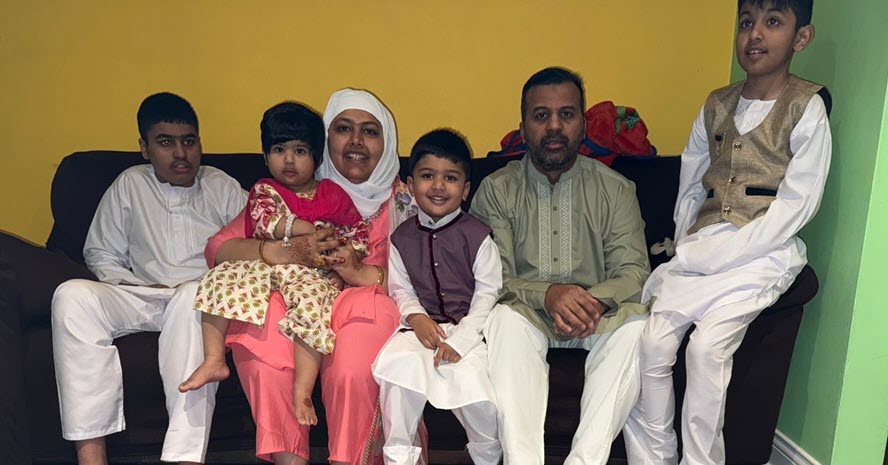
The family settled in Illinois, where Shakeb works as an operations manager for a healthcare company. Shafaq, a former finance manager for a multinational bank, stayed home to care for Sadaan.
At 5, Sadaan struggled to communicate, use the bathroom, and sit still for more than a few minutes. After a reassessment in Chicago, the family learned that Sadaan has profound autism. A commission of specialists has proposed calling autism profound when an autistic person needs 24-hour care throughout their lives, has little or no speech, and has intellectual disability.2, 3
Sadaan began receiving special education services at school and Applied Behavior Analysis therapy (ABA) at home. ABA is an evidence-based autism therapy. Shafaq went to every autism training that she could, so that she could help him, too.
Through the dedication of teachers and behavior therapists, Sadaan learned to use the bathroom, bathe, dress himself, eat with a spoon, sit still at school, and communicate using picture symbols, his mother says. Now, at 16, he is using a communication app on a tablet. He can also say approximations of words like food and bathroom to request those things.
His therapies and schooling all helped him, she says. “I feel like whatever we could achieve during all those years, it was lifesaving.”
A Different Child, A Different Kind of Autism
A year after arriving in the U.S., the family welcomed another son, Abdul. Autism sometimes runs in families, so Sadaan’s doctor watched Abdul for signs of the condition.
Abdul seemed different from his big brother. He learned to read and spell early. Once, when he was just 18 months old, Abdul began playing with blocks that had the letters of the alphabet on them. The toddler arranged the blocks so that they spelled out “Croation Cultural Center of Chicago.”
Shafaq was stunned. Where did he see those words? And how could he remember how to spell them?
She later discovered that there was a sign for the Croatian Cultural Center near a market where she shopped. She had never noticed it. But Abdul did.
Despite his early reading and memorization skills, Abdul had trouble with some tasks that are typically easy for youngsters. For example, he had trouble with stringing beads, interacting with others, and having a two-way conversation.
Abdul was diagnosed with autism, which affects him differently than Sadaan. Abdul is now a fifth grader who excels at school and loves languages. He knows English, Urdu, and Spanish, and he is learning Arabic, his mother says.
After Abdul, the family welcomed two more children, a son and a daughter, who do not have autism. “I’m teaching them English first because I want to make sure they’re able to converse with their brothers, because English is the predominant language in which they process,” says Shafaq, who speaks four languages. As she spoke, her two-year-old, Manha, sang the ABC alphabet song to her.
A Hope for Autism Research
Shafaq learned about SPARK from a flyer at a doctor’s office in 2016, soon after the autism study launched. The family joined and contributed saliva samples for researchers to analyze.
Shafaq wants to help scientists better understand profound autism. She hopes that research will lead to new ways of helping people like Sadaan live more independent lives, free from self-harming and aggressive behavior. “If you don’t help somebody find a solution, the solutions will never be found,” she says.
She also wants the public to be as aware and understanding of Sadaan’s end of the autism spectrum as they are of Abdul’s.
Autism in the Media
Television shows often portray autistic people as accomplished professionals or promising students, such as “The Good Doctor” Shaun Murphy, “Extraordinary Attorney Woo,” and students Max of “Parenthood” and Sam of “Atypical.”
“I think the media love affair with autism is a love affair with level 1 [mild] autism,” says Jill Escher, president of the National Council on Severe Autism, a nonprofit that promotes acceptance and policies to help people with severe autism. “If you are creating a story for TV or movies, you want something that will sell, like the brilliant autistic surgeon. What’s not going to sell is a story about someone like my son, who is nonverbal and can’t attend to his basic daily needs,” Escher says.
That may be why some people do not know about severe autism, Shafaq explains. “People are very accepting of Abdul because they know about his kind of autism: [They say,] ‘He’s super cool, he’s so intelligent, he can memorize things, he knows so many languages.’ That’s the awareness of autism that has been provided in the media,” she says.
“But when it comes to Sadaan, people have doubts that he’s autistic. Because they have never been shown the other side of the coin, where there are people on the spectrum who really, really need a lot of assistance. People like him have no place in the media,” she says.
She worries about how Sadaan will fare when she and his father are no longer able to care for him around the clock. “It’s difficult to really have a projection of how his life will be when we won’t be there to watch him,” she says. But she dreams of a future in which Sadaan can better care for himself. “I think that’s why SPARK really gives me hope,” she says.
Interested in joining SPARK? Here’s what you should know.
Photo provided by Gulnar Shafaq
References
- Zaraska M. The Transmitter (2021) https://www.thetransmitter.org/spectrum/moving-for-autism-care/. Accessed Sept. 10, 2025
- Lord C. et al. Lancet 399, 271-334 (2022) PubMed
- Wachtel L.E. et al. Pediatr. Clin. North Am. 71, 301-313 (2024) PubMed